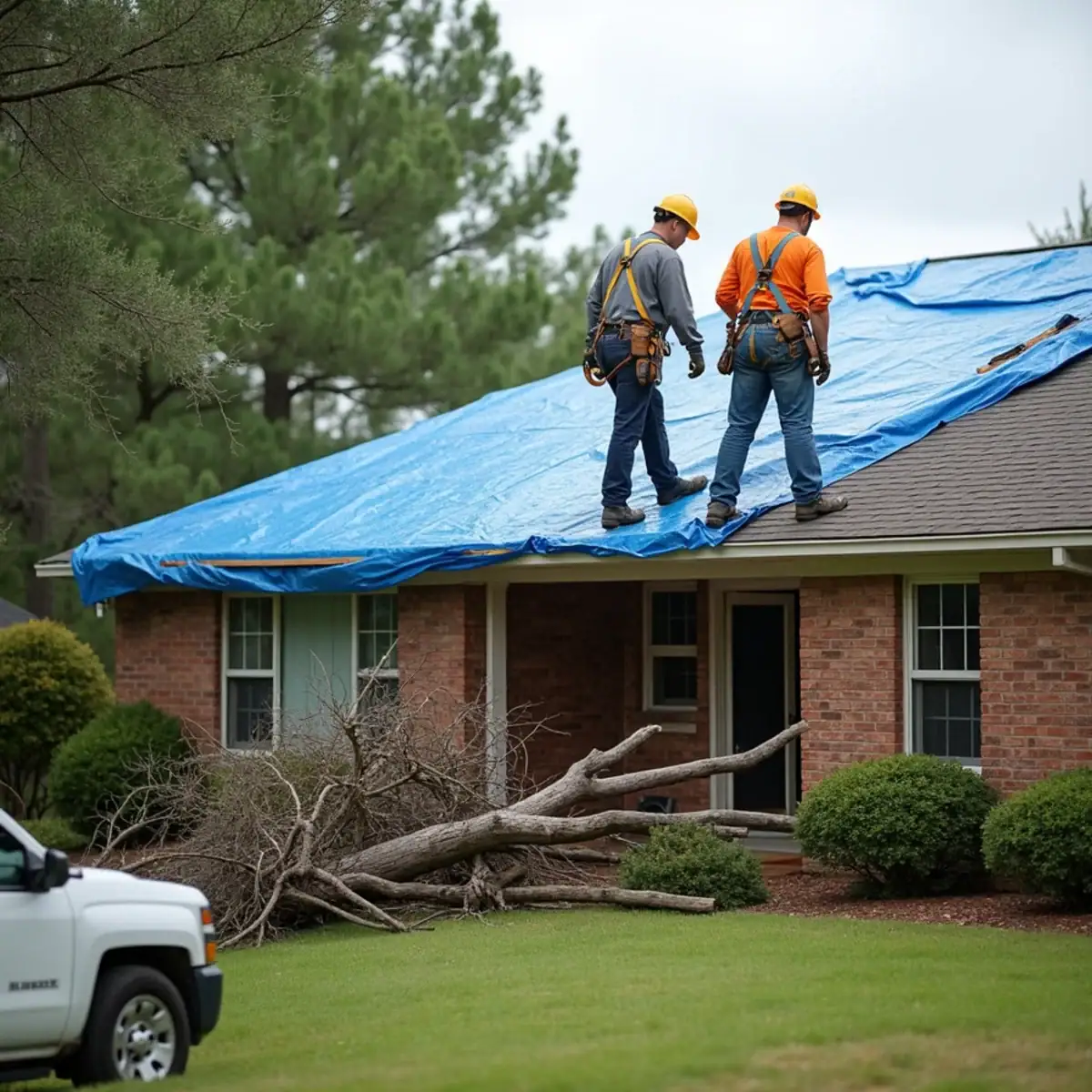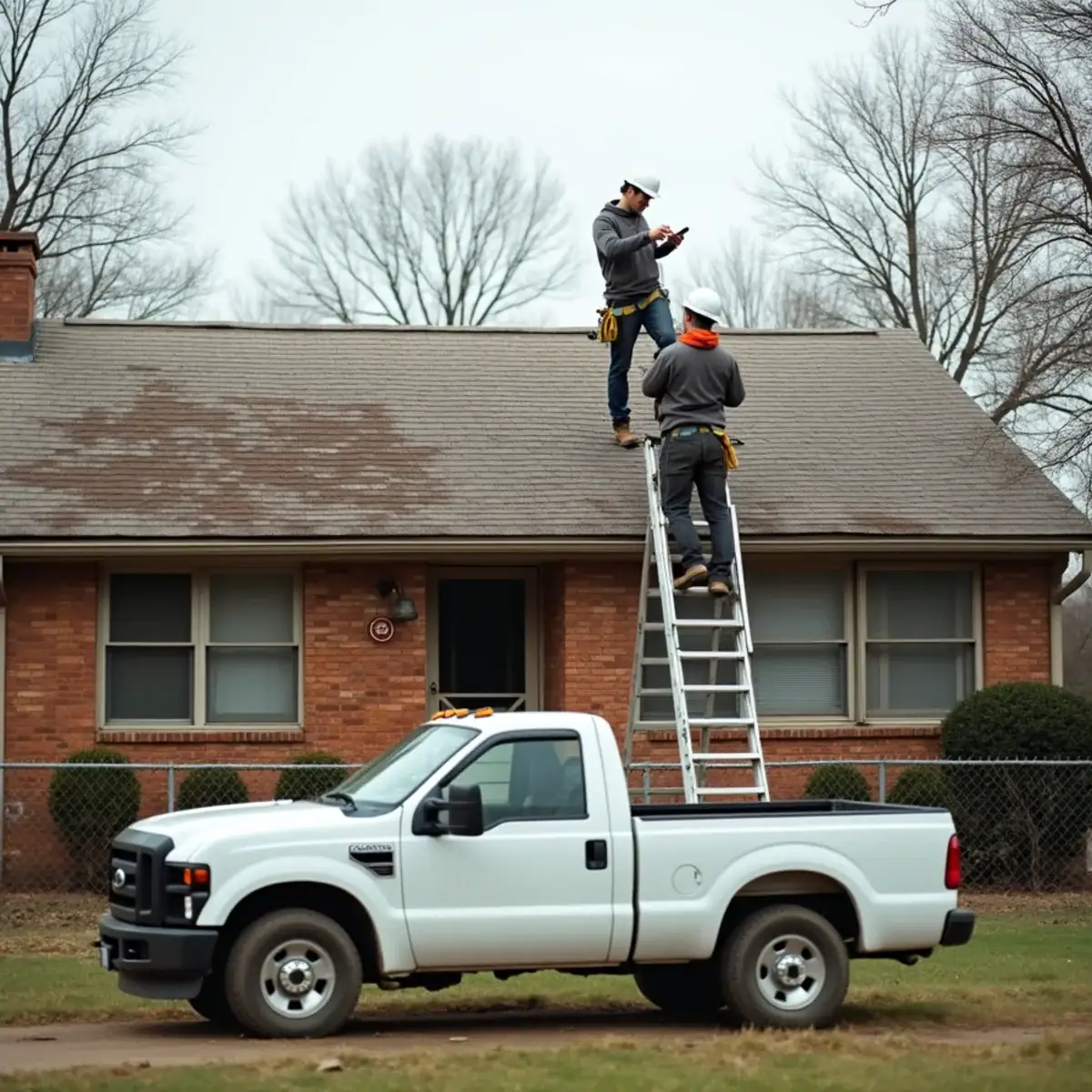
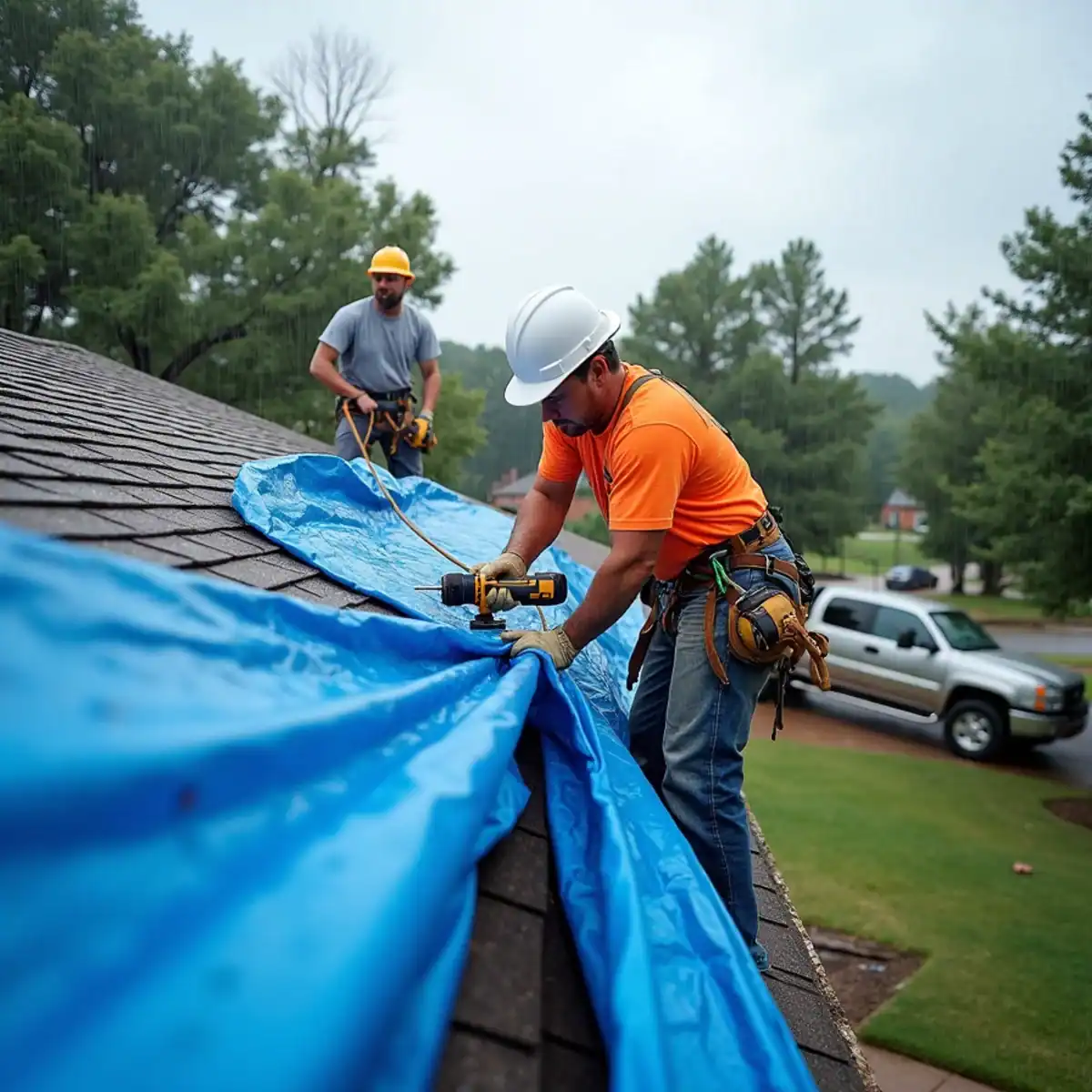
Call (773) 207-0769 for emergency roof tarping in Little Rock when a limb, a puncture or a run of missing shingles has left your roof open: the phone is answered 24/7 and a licensed roofer is sent to cover it once conditions are safe. A tarp is not the repair. It is a temporary cover that keeps water off the decking and out of the house until the permanent fix.
Here the usual causes are a limb from an old oak or pine, shingles torn off during a spring thunderstorm, or a repair that needs materials ordered while rain keeps coming. With about 50 inches of rain a year falling in heavy bursts, an open roof rarely stays dry for long. No roofer climbs in lightning, high wind or on ice, and nobody can promise an arrival time, so this page also covers what to do inside meanwhile.
When a roof needs a tarp instead of an immediate repair
A roofer tarps instead of repairing when a proper repair is not possible yet. The common reasons:
- It is dark or still raining. Shingles will not seal and underlayment will not stick to wet wood, but a tarp can go on in light rain once lightning and strong wind have passed.
- Materials must be ordered. Matching shingles for an older or discontinued roof, or extra decking, can take days.
- The damage needs a daylight look. After a limb strike, decking and rafters should be checked before anything permanent is built on them.
- Many roofs are open at once. After a hard spring storm, covering every open roof first protects more homes than fully repairing a few.
If the damage is small and the weather is dry, the roofer may skip the tarp and fix it outright; see emergency roof repair. A ceiling stain with no active drip usually calls for a scheduled roof leak repair rather than a tarp.
What an emergency tarping visit includes
A tarping visit is about one thing: getting the roof closed against the weather so it holds until the permanent repair. It typically covers:
- A safety check of the roof surface, decking and any limb before anyone puts weight on it
- Removal of small limbs, broken shingle pieces and debris from the area to be covered
- Plywood screwed over holes or broken decking so the tarp cannot sag and pond
- A heavy-duty blue or silver tarp sized with overlap and wrapped over the ridge where the roof allows
- Every edge rolled into 2x4 anchor boards and fastened, with exposed screw heads sealed
- Before-and-after photos and a dated written note of what was done
- A written estimate for the tarp up front, and a plan for the permanent repair
How emergency tarping works, start to finish
Most tarping calls follow the same five steps, whatever caused the opening.
- Call any hourTell the person who answers what opened the roof, where the water is going and the address. A licensed roofer is lined up with an honest idea of timing.
- Stay safe inside while you waitCatch the water, cut power to wet fixtures and keep people away from a sagging ceiling. Leave the roof and any limb alone.
- Roofer checks the roofOnce lightning and high wind have passed, the roofer inspects the damage, notes any weak decking and gives you a written estimate.
- Tarp installed and anchoredHoles are decked over, the tarp is run over the ridge, and every edge is rolled into 2x4 boards and screwed down.
- Permanent repair scheduledWhen the weather settles, the roofer returns to scope and price the real repair. The tarp comes off when that work is done.
How a roof tarp is installed so it holds: anchor boards, ridge wrap and sealed edges
A tarp weighed down with bricks or nailed through its grommets usually tears loose in the first gust. Roofers install it to resist wind and shed water:
- Clear and check. Loose debris and broken shingle pieces come off, and the roofer tests the decking around the opening.
- Size it generously. A heavy-duty blue or silver tarp is chosen to cover the damage with a few feet of overlap on every side.
- Wrap the ridge. Where the roof allows, the top of the tarp runs over the ridge onto the far slope, so water flowing down stays on top of the tarp instead of slipping under its upper edge.
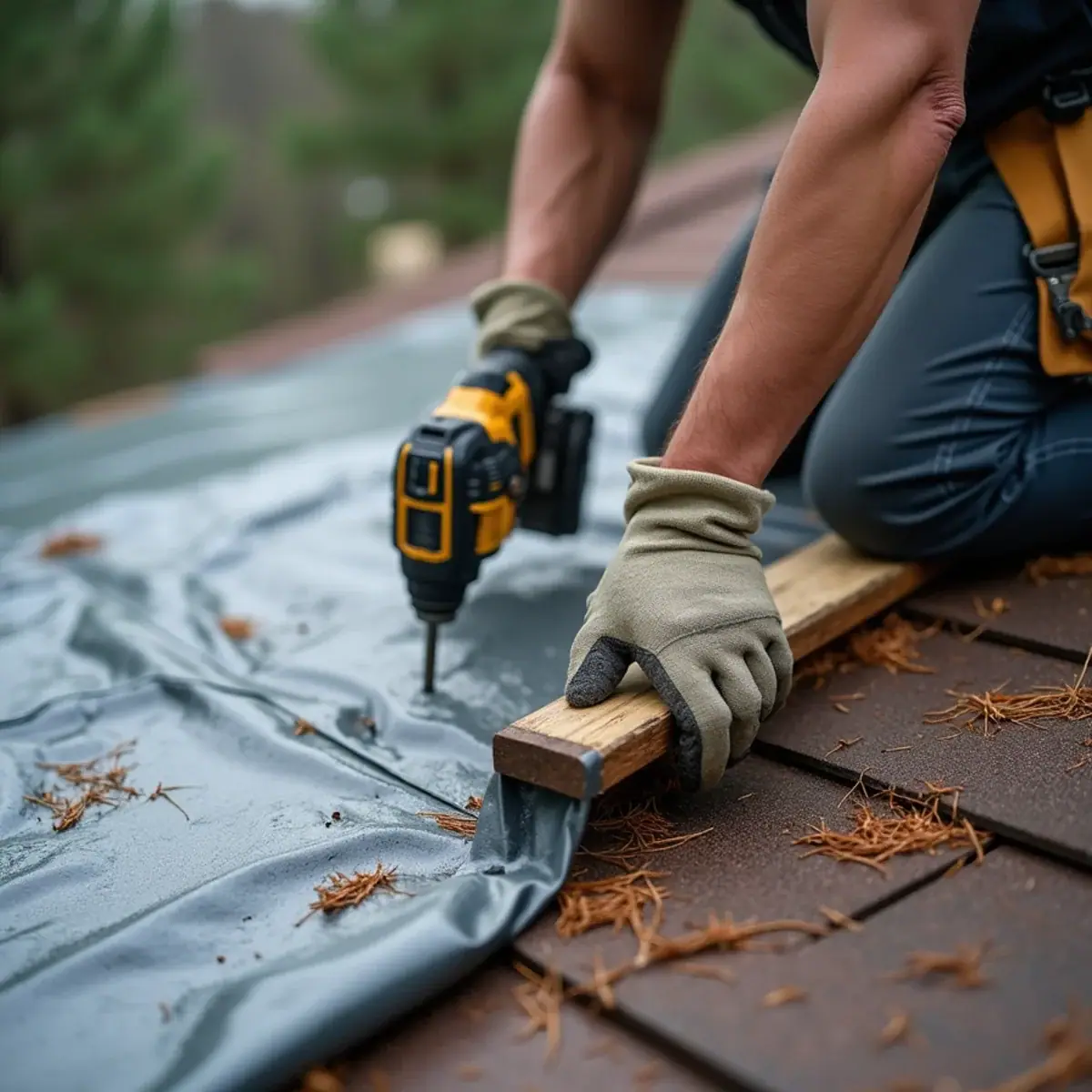
- Roll the edges into anchor boards. Each edge is wrapped around a 2x4 that is screwed down, sometimes with a second board on top. The boards spread the wind load along the whole edge.
- Seal and tidy. Exposed screw heads get sealant, loose flaps are tucked, and the roofer checks that runoff leaves the bottom edge at the gutter or eave.
On a steep Quapaw Quarter roof or a cut-up hip roof in Chenal Valley, expect more boards and careful folds around valleys and dormers.
Tarp grades and sizing: what actually goes on your roof
Most roof tarps are woven polyethylene coated on both sides. The grade shows in thickness (measured in mils, thousandths of an inch), the weave and the UV treatment.
| Tarp grade | What it is | Where it fits |
|---|---|---|
| Light-duty blue | Thin woven poly, often around 5 mil, coated on both sides | A few days, or a small cover while materials arrive |
| Heavy-duty silver | Often 10 mil or more, tighter weave, reinforced hems | The usual pick when the repair is weeks away; the silver face reflects sun and lasts longer |
| Extra-heavy reinforced | Commonly 18 mil and up, with reinforcing in the weave | Longer waits for ordered shingles or decking work |
Sizing the tarp
- Past the damage: roughly 4 feet beyond the damage on every side, because water travels sideways under shingles.
- Over the ridge: the top edge runs 3 to 4 feet down the far slope, where water flows away from it.
- To the eave: the bottom edge reaches the roof edge so runoff drops into the gutter.
- More than one tarp: the lower tarp goes on first and the one above laps over it by about 2 feet, the same way shingles overlap.
Anchor boards, sandbags or cap nails: how the tarp is held down
The method depends on the pitch and how long the cover has to stay.
| Method | How it works | When roofers use it | Weak spot |
|---|---|---|---|
| Anchor boards (battens) | Tarp edge rolled at least twice around a 2x4, screwed through into the decking | Most pitched shingle roofs, and any tarp staying more than a night or two | Leaves screw holes that are sealed at repair time |
| Sandbags | Bags set along edges and corners a few feet apart, no fasteners | Low-slope porches and very short covers in calm weather | Slide on a pitch, shift in heavy rain, leave loose edges for a gust to lift |
| Cap nails | Nails with a wide plastic cap that pin the tarp to a board | Holding the tarp snug against the anchor board between screws | Driven through bare tarp alone, they tear out in the first gust |
Where the fasteners go matters as much as the method. Screws go through the boards into solid decking, commonly every 12 to 16 inches, never through a shingle into empty space. Side boards run straight down the slope so water flows along them instead of damming behind them. When the tarp comes off, the roofer seals or replaces the shingles at every screw hole as part of the permanent repair.
Tree limbs, punctures and open decking
Little Rock's mature oaks and pines are the most common reason a roof needs a tarp at all.
When the limb is still on the roof
Small limbs are lifted off before tarping. A large limb or a whole tree resting on the house needs a tree service to take the weight off safely, because a cut in the wrong place can drop it further into the roof. Stay out of the rooms below and away from any wires it touched.
Punctures and broken decking
A tarp laid straight over a hole sags into it and holds a pool of water. Roofers trim the broken decking and screw plywood over the opening first, then tarp over the plywood. If the wood around it is soaked or rotted, plan on roof decking repair as part of the permanent fix.
Bare decking
Where shingles and underlayment have blown away, the tarp covers the exposed wood. Once the deck dries, some roofers add self-adhered membrane for a tighter seal.
Valleys, chimneys, vents and low-slope porches: tarping the awkward spots
Open slopes are the easy part. Most leaks under a tarp start where the roof changes direction or something pokes through it.
Valleys
A valley carries the runoff from two slopes, so no boards or screws go in it. The tarp is laid smooth through the valley, or two tarps meet there with the upper one lapped over the lower, and the boards stay on the slopes to either side. West Little Rock hip-and-valley roofs often need this on every cover.
Chimneys and vents
No holes are cut in the tarp. It is folded up against the uphill side of the chimney, where the most water hits, and the edges are taped or sealed. Plumbing stacks and attic vents are worked around rather than sealed under plastic, so the attic can still breathe in humid weather.
Low-slope porches and additions
On a back porch or an add-on room with barely any pitch, water does not run off on its own. A tarp there tends to sag and hold a pond that stretches the material and adds weight. Roofers prop it with boards underneath so it crowns slightly and drains toward the edge.
How long a tarp lasts, and what happens next
A heavy-duty tarp with anchor boards and a ridge wrap often holds for 30 to 90 days. Arkansas sun breaks the material down, and every heavy rain and gusty afternoon tests the edges.
- Look at it from the ground after every hard rain. A lifting corner or loose board needs attention before it lets go.
- Watch the ceiling below. A new stain means water is getting past the cover.
- Keep the gutters under the tarp clear so runoff can drain.
- Do not leave it through a whole season. The longer it stays, the more trapped heat and moisture wear on the shingles and decking beneath.
What a failing tarp looks like from the ground
- Edges curling or cracking, or a faded, chalky surface: the UV coating has worn off
- A belly of water sitting on the tarp, or a sag that was not there last week
- An anchor board that has shifted, lifted at one end or pulled away from the edge
- Flapping you can hear from inside on a breezy night
- Small tears or pinholes near the boards, where the material works back and forth
Next, the roofer comes back to scope the permanent work: decking, underlayment, shingles and flashing as needed, priced in writing. The tarp comes off the day that work is done. For a few missing shingles on an otherwise sound roof, the follow-up is usually a missing shingle repair.
Photos and receipts to keep from the night of the damage
A few minutes with your phone that night saves guessing later, for you, for the roofer who does the permanent repair and for anyone else who needs to see what happened. Keep these together in one folder:
- Photos and short videos of damage inside, ceilings, walls, floors and wet belongings, before cleanup
- Photos of the roof and any limb from the ground, taken before anything is moved
- The roofer's before-and-after photos of the tarp
- The dated written estimate and invoice for the tarping
- Receipts for tree removal, water cleanup, fans or a hotel night
- Notes on when the leak started and what you did to limit it
Shoot the inside before you mop up: a soaked rug and a dripping ceiling show more than a dried-out room the next day. Keep the photos and receipts for your records or your insurer. Landlords should also save tenant messages and dates; our landlord roof leak checklist has a fuller list.

The risks of tarping a roof yourself: wet shingles, steep pitch and power lines
Climbing up with a hardware-store tarp is tempting. It is also how many roof falls happen.
- Wet shingles are slick. Rain, wet leaves and pine needles turn even a low ranch roof into a slide.
- Steep pitch. Many older Little Rock homes have steep roofs that need a harness and anchor to work safely.
- A tarp is a sail. One gust can pull a person holding a big tarp off balance, or off the ladder.
- Power lines. Service lines and limbs tangled in wires can be live, and aluminum ladders conduct.
- Weak decking. The wood around a puncture may be too soft to stand on.
The safer job is inside: catch the water, cut power to wet fixtures and ease a bulging ceiling. If you plan to cover a small, low area yourself in dry daylight, read our guide on how to tarp a leaking roof safely first, including when not to climb.
What affects roof tarping cost
Tarping is priced per job once the roofer sees the roof. The main things that move the number:
- Size of the area and the tarp it takes, including the ridge wrap
- Pitch and height: steep and two-story roofs need more safety setup
- Roof shape: valleys, dormers and chimneys mean more boards and folds
- Plywood needed over holes before the tarp goes on
- Limb removal by a tree service, usually billed separately
- Time of the call: some roofers charge more for nights, weekends and holidays
- Distance to your home in Little Rock or one of the nearby cities we serve
- Return visits to re-secure or replace a tarp
If the same roofer will do the permanent repair, ask how the tarping is handled on that bill, and whether a check-up visit after a windy week is part of the price. The roofer gives you a written estimate before work starts.
Why Little Rock homeowners call Little Rock Shingle Roofers for a roof tarp
- Answered 24/7Limbs come down at 2 a.m. and on holiday weekends. A person answers every hour of every day and lines up a roofer.
- Licensed and insured in ArkansasEvery roofer we send is licensed and insured in Arkansas. Little Rock Shingle Roofers connects you with independent licensed roofers who perform the work.
- The estimate comes firstYou see the price for the tarp in writing before anyone climbs, including any after-hours charge.
- A cover tonight, no pressureThe night of the damage is for closing the roof, not for big decisions. The roofer explains the repair options later, once the roof can be looked at properly in daylight.
Emergency Roof Tarping questions from Little Rock homeowners
How fast can a tarp be installed in Little Rock?
That depends on when a roofer can reach you and how big the job is. Arrival depends on the hour, the weather and how many roofs are open, so we do not promise a time; you hear an honest estimate when you call. Once the roofer is on the roof, a single opening on one slope often takes an hour or two to tarp properly. Large, steep or cut-up roofs take longer.
How long can a tarp stay on a roof?
Usually a few weeks, and rarely more than about three months. Arkansas sun breaks down tarp material, and every heavy rain and gust strains the anchor boards. Treat the tarp as a bridge to the permanent repair, not a substitute for it. Check it from the ground after each storm and call if a corner lifts or a new stain appears inside. Booking the repair early keeps the tarp's time on the roof short.
Can you tarp a roof at night or in the rain?
Usually, yes, as long as there is no lightning, high wind or ice. With proper lighting and in light, steady rain, roofers can often install a tarp after dark. In a downpour with strong gusts or lightning nearby, the roofer waits for it to pass. Meanwhile, catch the water inside, cut power to wet fixtures and keep people out of rooms with a bulging ceiling. The roofer makes the final safety call on site.
Will the tarp damage my shingles?
Not usually, if it is installed correctly and removed on time. Anchor boards are fastened with screws, and those holes are sealed or covered during the permanent repair; many roofers place the boards over areas being repaired anyway. Trouble comes from tarps left on for months, which scuff granules as they flap and trap heat against the shingles, or from tarps nailed through grommets that tear loose.
Can you tarp a rental house if I live out of town?
Yes. Many homes around Little Rock and Jacksonville are rentals owned by people who live elsewhere, including service members stationed away from Little Rock Air Force Base. Call with the address and the tenant's contact details. The roofer arranges access, and you get the written estimate before work starts, along with photos of the finished tarp for your records.
Is a tarp enough for a leak around a chimney or skylight?
Not always. Tarps work best on open slopes. Around a masonry chimney on an older Hillcrest or Heights house, or around a skylight, water can still get in along the sides where a tarp cannot seal tightly. Roofers often pair a smaller tarp with temporary sealant or membrane at the flashing, then schedule roof flashing and chimney leak repair as the permanent fix.
Do roofers use sandbags to hold a tarp down?
Not usually, on a pitched shingle roof. Sandbags slide on a slope, shift in heavy rain and leave edges loose enough for a gust to lift. Roofers keep them for low-slope porches or a cover that only has to last a calm night. On most Little Rock roofs, the edges are rolled into 2x4 anchor boards screwed into the decking.
Will the tarp cover my roof vents?
No, not when it is installed properly. Plumbing stacks, attic vents and exhaust caps are worked around or left room to breathe, because sealing them under plastic traps heat and humid air in the attic. If a vent sits in the damaged area, the roofer covers the opening around it and seals the tarp edge at the vent instead of smothering it.
Is shrink wrap better than a tarp for a big hole?
Not always. Shrink wrap is heavy plastic sheeting fastened around the edges and heated until it pulls drum-tight, so it covers a large opening without seams and usually outlasts a tarp. It needs special equipment and more time, so some contractors keep it for very large openings, such as a tree through several rafters, or covers that must stay for months. For a limb strike or a run of missing shingles, a heavy tarp with anchor boards is usually the right cover.
Page reviewed by Little Rock Shingle Roofers.